Quantitative Methods
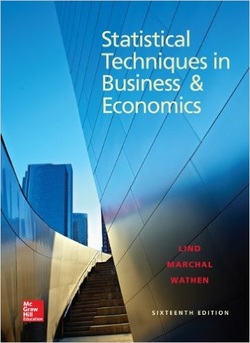
Textbook: Statistical Techniques for Business and Economics (16e), by Lind, Marchal, and Wathan, McGraw-Hill, 2015. ISBN: 978-0078020520
Lind, Marchal, and Wathen official website
Go to this website for the PPT slides, tutorials, videos, datasets, quizzes, study guides, and other important chapter-by-chapter information.
TAMU Software Store
Z-tables and T-tables, F-tables
Chi-Square table
Binomial tables
Key Formulas
Join the Slack Team Page
Lind, Marchal, and Wathen official website
Go to this website for the PPT slides, tutorials, videos, datasets, quizzes, study guides, and other important chapter-by-chapter information.
TAMU Software Store
Z-tables and T-tables, F-tables
Chi-Square table
Binomial tables
Key Formulas
Join the Slack Team Page
CHAPTER MATERIAL
Helpful online learning tools:
|

|
|
|
|
| ||||||||||
Chapter 11: Two-Sample Test of Hypothesis
When you have completed this chapter, you will be able to:
LO11-1 Test a hypothesis that two independent population means are equal, assuming that the population standard deviations are known and equal.
LO11-2 Test a hypothesis that two independent population means are equal, with unknown population standard deviations.
LO11-3 Test a hypothesis about the mean population difference between paired or dependent observations.
LO11-4 Explain the difference between dependent and independent samples.
LO11-1 Test a hypothesis that two independent population means are equal, assuming that the population standard deviations are known and equal.
LO11-2 Test a hypothesis that two independent population means are equal, with unknown population standard deviations.
LO11-3 Test a hypothesis about the mean population difference between paired or dependent observations.
LO11-4 Explain the difference between dependent and independent samples.
|
| |||
Chapter 12: Analysis of Variance
When you have completed this chapter, you will be able to:
LO12-1 Apply the F distribution to test a hypothesis that two population variances are equal.
LO12-2 Use ANOVA to test a hypothesis that three or more population means are equal.
LO12-3 Use confidence intervals to test and interpret differences between pairs of population means.
LO12-4 Use a blocking variable in a two-way ANOVA to test a hypothesis that three or more population means are equal.
LO12-5 Perform a two-way ANOVA with interaction and describe the results
LO12-1 Apply the F distribution to test a hypothesis that two population variances are equal.
LO12-2 Use ANOVA to test a hypothesis that three or more population means are equal.
LO12-3 Use confidence intervals to test and interpret differences between pairs of population means.
LO12-4 Use a blocking variable in a two-way ANOVA to test a hypothesis that three or more population means are equal.
LO12-5 Perform a two-way ANOVA with interaction and describe the results
|
|
| ||||
Chapter 13: Correlation and Linear Regression
When you have completed this chapter, you will be able to:
LO13-1 Explain the purpose of correlation analysis.
LO13-2 Calculate a correlation coefficient to test and interpret the relationship between two variables.
LO13-3 Apply regression analysis to estimate the linear relationship between two variables.
LO13-4 Evaluate the significance of the slope of the regression equation.
LO13-5 Evaluate a regression equation’s ability to predict using the standard estimate of the error and the coefficient of determination.
LO13-6 Calculate and interpret confidence and prediction intervals.
LO13-7 Use a log function to transform a nonlinear relationship.
LO13-1 Explain the purpose of correlation analysis.
LO13-2 Calculate a correlation coefficient to test and interpret the relationship between two variables.
LO13-3 Apply regression analysis to estimate the linear relationship between two variables.
LO13-4 Evaluate the significance of the slope of the regression equation.
LO13-5 Evaluate a regression equation’s ability to predict using the standard estimate of the error and the coefficient of determination.
LO13-6 Calculate and interpret confidence and prediction intervals.
LO13-7 Use a log function to transform a nonlinear relationship.
| ipptch013.pptx |
| copiersandsales.xlsx |
|
|
|
|
|
|
|
|
Chapter 14: Multiple Regression Analysis
When you have completed this chapter, you will be able to:
LO14-1 Use multiple regression analysis to describe and interpret a relationship between several independent variables and a dependent variable.
LO14-2 Evaluate how well a multiple regression equation fits the data.
LO14-3 Test hypotheses about the relationships inferred by a multiple regression model.
LO14-4 Evaluate the assumptions of multiple regression.
LO14-5 Use and interpret a qualitative, dummy variable in multiple regression.
LO14-6 Include and interpret an interaction effect in multiple regression analysis.
LO14-7 Apply stepwise regression to develop a multiple regression model.
LO14-8 Apply multiple regression techniques to develop a linear model.
LO14-1 Use multiple regression analysis to describe and interpret a relationship between several independent variables and a dependent variable.
LO14-2 Evaluate how well a multiple regression equation fits the data.
LO14-3 Test hypotheses about the relationships inferred by a multiple regression model.
LO14-4 Evaluate the assumptions of multiple regression.
LO14-5 Use and interpret a qualitative, dummy variable in multiple regression.
LO14-6 Include and interpret an interaction effect in multiple regression analysis.
LO14-7 Apply stepwise regression to develop a multiple regression model.
LO14-8 Apply multiple regression techniques to develop a linear model.
Table 14-1 (Heating Cost Data)
|
|
| ||
Chapter 15: Nonparametric Methods: Nominal Level Hypothesis Tests
When you have completed this chapter, you will be able to:
LO15-1 Test a hypothesis about a population proportion.
LO15-2 Test a hypothesis about two population proportions.
LO15-3 Test a hypothesis comparing an observed set of frequencies to an expected frequency distribution.
LO15-4 Explain the limitations of using the chi-square statistic in goodness-of-fit tests.
LO15-5 Test a hypothesis that an observed frequency distribution is normally distributed.
LO15-6 Perform a chi-square test for independence on a contingency table.
LO15-1 Test a hypothesis about a population proportion.
LO15-2 Test a hypothesis about two population proportions.
LO15-3 Test a hypothesis comparing an observed set of frequencies to an expected frequency distribution.
LO15-4 Explain the limitations of using the chi-square statistic in goodness-of-fit tests.
LO15-5 Test a hypothesis that an observed frequency distribution is normally distributed.
LO15-6 Perform a chi-square test for independence on a contingency table.
|
|
| ||
Chapter 16: Nonparametric Methods: Analysis of Ordinal Data
When you have completed this chapter, you will be able to:
LO16-1 Use the sign test to compare two dependent populations.
LO16-2 Test a hypothesis about a median using the sign test.
LO16-3 Test a hypothesis of dependent populations using the Wilcoxon signed-rank test.
LO16-4 Test a hypothesis of independent populations using the Wilcoxon rank-sum test.
LO16-5 Test a hypothesis of several independent populations using the Kruskal-Wallis test.
LO16-6 Test and interpret a nonparametric hypothesis test of correlation.
LO16-1 Use the sign test to compare two dependent populations.
LO16-2 Test a hypothesis about a median using the sign test.
LO16-3 Test a hypothesis of dependent populations using the Wilcoxon signed-rank test.
LO16-4 Test a hypothesis of independent populations using the Wilcoxon rank-sum test.
LO16-5 Test a hypothesis of several independent populations using the Kruskal-Wallis test.
LO16-6 Test and interpret a nonparametric hypothesis test of correlation.
| |||
Chapter 17: Index Numbers
When you have completed this chapter, you will be able to:
LO17-1 Compute and interpret a simple, unweighted index.
LO17-2 Compute and interpret an unweighted aggregate index.
LO17-3 Compute and interpret a weighted aggregate index.
LO17-4 List and describe special-purpose indexes.
LO17-5 Apply the Consumer Price Index.
LO17-1 Compute and interpret a simple, unweighted index.
LO17-2 Compute and interpret an unweighted aggregate index.
LO17-3 Compute and interpret a weighted aggregate index.
LO17-4 List and describe special-purpose indexes.
LO17-5 Apply the Consumer Price Index.
| |||||
Chapter 18: Times Series and Forecasting
When you have completed this chapter, you will be able to:
LO18-1 Define and describe the components of a time series.
LO18-2 Smooth a time series by computing a moving average.
LO18-3 Smooth a time series by computing a weighted moving average.
LO18-4 Use regression analysis to fit a linear trend line to a time series.
LO18-5 Use regression analysis to fit a nonlinear time series.
LO18-6 Compute and apply seasonal indexes to make seasonally adjusted forecasts.
LO18-7 Deseasonalize a time series using seasonal indexes.
LO18-8 Conduct a hypothesis test of autocorrelation.
LO18-1 Define and describe the components of a time series.
LO18-2 Smooth a time series by computing a moving average.
LO18-3 Smooth a time series by computing a weighted moving average.
LO18-4 Use regression analysis to fit a linear trend line to a time series.
LO18-5 Use regression analysis to fit a nonlinear time series.
LO18-6 Compute and apply seasonal indexes to make seasonally adjusted forecasts.
LO18-7 Deseasonalize a time series using seasonal indexes.
LO18-8 Conduct a hypothesis test of autocorrelation.
|
|
| ||||||
Chapter 19: Statistical Process Control and Quality Management
When you have completed this chapter, you will be able to:
LO19-1 Explain the purpose of quality control in production and service operations.
LO19-2 Define the two sources of process variation and explain how they are used to monitor quality.
LO19-3 Explain the use of charts to investigate the sources of process variation.
LO19-4 Compute control limits for mean and range control charts for a variable measure of quality.
LO19-5 Evaluate control charts to determine if a process is out of control.
LO19-6 Compute control limits of control charts for an attribute measure of quality.
LO19-7 Explain the process of acceptance sampling.
LO19-1 Explain the purpose of quality control in production and service operations.
LO19-2 Define the two sources of process variation and explain how they are used to monitor quality.
LO19-3 Explain the use of charts to investigate the sources of process variation.
LO19-4 Compute control limits for mean and range control charts for a variable measure of quality.
LO19-5 Evaluate control charts to determine if a process is out of control.
LO19-6 Compute control limits of control charts for an attribute measure of quality.
LO19-7 Explain the process of acceptance sampling.
| ||||
Chapter 20: An Introduction to Decision Theory
When you have completed this chapter, you will be able to:
LO20-1 Identify and apply the three components of a decision.
LO20-2 Analyze a decision using expected monetary value.
LO20-3 Analyze a decision using opportunity loss.
LO20-4 Apply maximin, maximax, and minimax regret strategies to make a decision.
LO20-5 Compute and explain the expected value of perfect information.
LO20-6 Apply sensitivity analysis to evaluate a decision subject to uncertainty.
LO20-7 Use a decision tree to illustrate and analyze decision making under uncertainty.
LO20-1 Identify and apply the three components of a decision.
LO20-2 Analyze a decision using expected monetary value.
LO20-3 Analyze a decision using opportunity loss.
LO20-4 Apply maximin, maximax, and minimax regret strategies to make a decision.
LO20-5 Compute and explain the expected value of perfect information.
LO20-6 Apply sensitivity analysis to evaluate a decision subject to uncertainty.
LO20-7 Use a decision tree to illustrate and analyze decision making under uncertainty.
|

|
| |||||||