LAWRENCE MCNEIL, PH.D.
  • Home
  • BLOG
  • About
  • Academy
    • Research
    • Courses >
      • Concepts of Economic Analysis
      • Principles of Macroeconomics
      • Fundamentals of Economics >
        • ECON 2003 Advice from Students
      • Economic Development
      • Economics of Innovation >
        • Peer Performance Review
      • Economics for Entrepreneurs
      • International Trade >
        • Trade Peer Performance Review
      • Quantitative Methods
      • Business Ethics and Law
      • Business Statistics
      • McGraw-Hill Connect
    • Travel >
      • Travel Blog
      • Australia >
        • Australia Images 2019
        • Australia Overview
      • South Africa >
        • South Africa Images 2018
        • South Africa Images 2017
  • Resources
    • White Papers
    • Podcasts
    • Books
    • Curated Lists

Does Your Syllabus Need Work?

1/9/2024

0 Comments

 
Picture
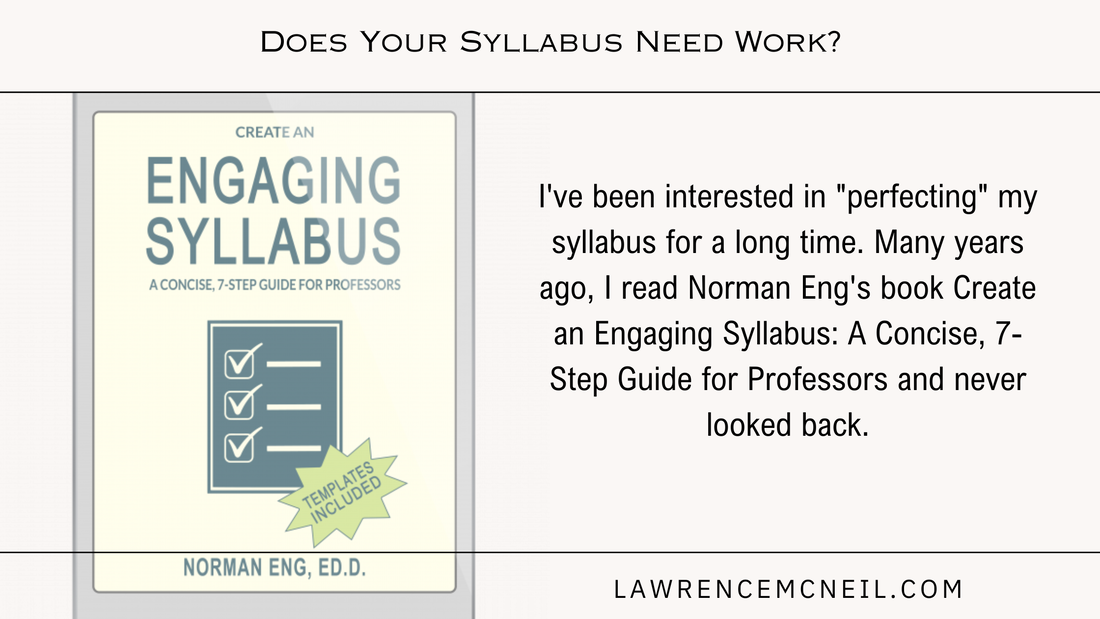
I've been interested in "perfecting" my syllabus for a long time. Many years ago, I read Norman Eng's book Create an Engaging Syllabus: A Concise, 7-Step Guide for Professors and never looked back.

Dr. Eng provides a quick read with templates that resulted in my new syllabus, which has received many complements through the years. It's funny - when a student or professor colleague see my syllabus for the first time, a common reaction is "Wow, this makes me want to take your course." Following Dr. Eng's model and templates, I place a major emphasis on the AIDA framework:

"To help, think of the marketing acronym, AIDA, which stands for Attention, Interest, Desire, and Action. This means your syllabus needs to: 1) get students’ attention; 2) get them interested in reading further; 3) increase their desire to learn; and 4) get them to do something—in this case, to show up to class every day ready." -Norman Eng

The 7 Steps
I recommend all professors read this book and seriously consider the changes recommended by Dr. Eng, which are layered into 7 steps:

1. Think of your syllabus as a sales brochure.
2. Define your big picture question(s) and opening.
3. Vet your topics, readings, and assignments.
4. Put your objectives and outcomes in the back.
5. Optimize your language.
6. Utilize feature boxes and sidebars.
7. Design for visual appeal.
8. Conclusion

I think it's critical to make a syllabus that creates excitement among students. Your syllabus should reflect your joy of teaching and your commitment to student empowerment and success. Regardless of your class being required or an elective, an inviting, extremely clear, and visually-appealing syllabus will set the necessary tone for the class and create a sense of positive anticipation among your students.

"Students know if you care. They sense passion. Your syllabus embodies who you are." -Norman Eng
0 Comments


Leave a Reply.

    Archives

    January 2024
    June 2021
    September 2020
    March 2019
    December 2018
    September 2018
    August 2018
    July 2018
    October 2017
    August 2017

    Categories

    All
    Apps
    Productivity

    RSS Feed

    Newsletter coming soon.  
    ​Sign up now.

Submit


Copyright 2024 Lawrence McNeil, Ph.D.
  • Home
  • BLOG
  • About
  • Academy
    • Research
    • Courses >
      • Concepts of Economic Analysis
      • Principles of Macroeconomics
      • Fundamentals of Economics >
        • ECON 2003 Advice from Students
      • Economic Development
      • Economics of Innovation >
        • Peer Performance Review
      • Economics for Entrepreneurs
      • International Trade >
        • Trade Peer Performance Review
      • Quantitative Methods
      • Business Ethics and Law
      • Business Statistics
      • McGraw-Hill Connect
    • Travel >
      • Travel Blog
      • Australia >
        • Australia Images 2019
        • Australia Overview
      • South Africa >
        • South Africa Images 2018
        • South Africa Images 2017
  • Resources
    • White Papers
    • Podcasts
    • Books
    • Curated Lists